
Antarctica's Thwaites Glacier could add twice as much to sea-level rise by 2100 as thought, new study finds
In one minute
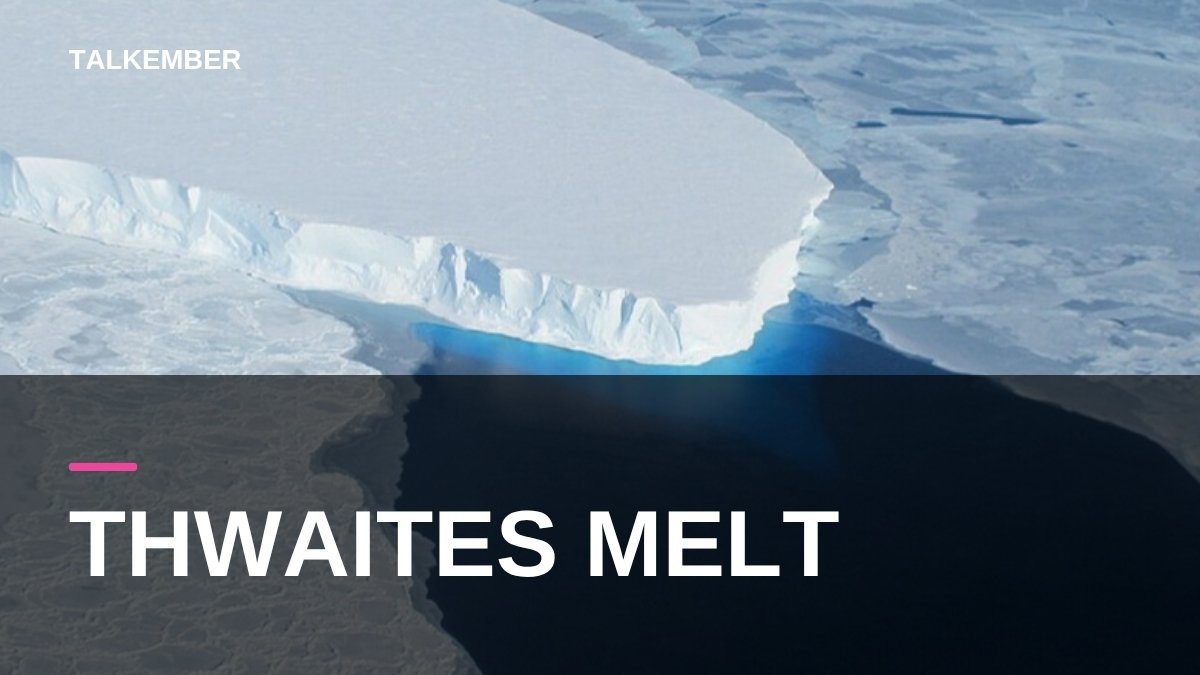
A peer-reviewed model by UC Irvine and NASA JPL scientists, published in Nature Communications, projects that Antarctica's Thwaites Glacier could add up to about 30 mm to global sea levels by 2100, roughly double earlier projections, even without further warming. The key change is modelling warm seawater seeping kilometres under the ice.
Key takeaways
- A new computer model of Thwaites Glacier in West Antarctica projects it could add up to 30 mm (±6 mm) to global average sea level by 2100, about double earlier projections.
- That figure assumes no extra climate warming beyond today's conditions.
- The difference comes from modelling a "grounding zone" several kilometres wide, where warm seawater seeps beneath ice that rests on the seabed, instead of a single thin "grounding line".
- The model suggests Thwaites could come loose from an undersea ridge that currently steadies it as early as 2038, with about a 60% chance of that happening by the end of the century.
- The study, led by scientists at the University of California, Irvine and NASA's Jet Propulsion Laboratory, was published on 12 October in Nature Communications.
What the scientists found
Ice-sheet models have usually treated the point where a glacier lifts off the seabed and starts to float as a sharp line. Satellite radar shows something different at Thwaites: seawater pushes several kilometres under the grounded ice and lifts it with the tides, bringing warm water into contact with the ice and melting it from below.
When the team added a 2–5 km wide melting zone to their model, it could reproduce nearly three decades of observed retreat, thinning and speed-up at Thwaites (1996–2023). Models without it struggled to match how fast the glacier has been losing ice, which is why earlier projections may have been too low, the researchers say.
| Measure | Earlier average | New model |
|---|---|---|
| Thwaites' sea-level contribution by 2100 (no extra warming) | about 15 mm | about 30 mm |
| Width of melting zone under the ice | treated as a line | 2–5 km |
| Earliest unpinning from Mouginot Ridge | — | 2038 |
Earlier average from the multi-model comparison cited in the study, as summarised by Eigen Radar.
Lead author Mattia Poinelli said the glacier is being "temporarily stabilized" by the Mouginot Ridge, and once it loses that grip it would keep retreating across a downward-sloping seabed towards the next high point, the South Ridge. Co-author Eric Rignot of UC Irvine said the new model matches the observed record and then "produces projections that are twice larger than before".
Why Thwaites matters
According to the study, Thwaites holds enough ice to raise global sea level by about 65 cm if it all melted, and the Amundsen Sea area it sits in accounts for roughly one third of the ice lost from Antarctica. It has retreated about 25 km in its fastest-flowing western sector since the mid-1990s, the paper says.
What it means for Pakistan and India
Thirty millimetres sounds small, but it is the projected contribution of just one glacier. Pakistan and India both have long coastlines and large coastal cities such as Karachi, Mumbai and Kolkata. The researchers say their results point to "greater risk of and exposure for coastal flooding" than anticipated in the coming decades, and Rignot said higher sea levels should be expected even if emissions are cut, because of damage already done.
Limits of the study
- The projections are model results for one glacier and depend on its physical assumptions, as Eigen Radar notes.
- The 30 mm figure is for constant climate conditions; further warming could change the outcome.
- Other research groups will need to test the grounding-zone approach on Thwaites and other glaciers.
What to watch
- Whether other ice-sheet models adopt the grounding-zone approach, which could change estimates for other Antarctic glaciers too.
- New satellite and field measurements of the Mouginot Ridge area, where the model expects the next big change at Thwaites.
Sources
- Nature Communications — Sea-level contribution from Thwaites Glacier doubles in an observation-constrained ice-sheet model (Poinelli et al., 2026)
- UC Irvine Earth System Science — UC Irvine, NASA JPL: Melting of Antarctica's Thwaites Glacier worse than thought
- Eigen Radar — Thwaites model doubles sea-level contribution when seawater reaches grounded ice
Spotted a mistake? Tell us — we fix errors and log them on our corrections page.
#thwaites-glacier#sea-level-rise#antarctica#climate-change#nasa-jpl#science#coastal-cities
Comments (0)