
Is this the strongest El Niño ever? Japan says yes, the US says not yet: why weather agencies disagree
In one minute
Japan's weather agency says this year's El Niño is the strongest on record, and Britain's Met Office calls it unprecedented, but US forecasters say it still trails the biggest past events by their measure. The difference comes down to which patch of the Pacific each agency watches and how it defines "normal" in a warming climate. All agree it is a very strong event.
Key takeaways
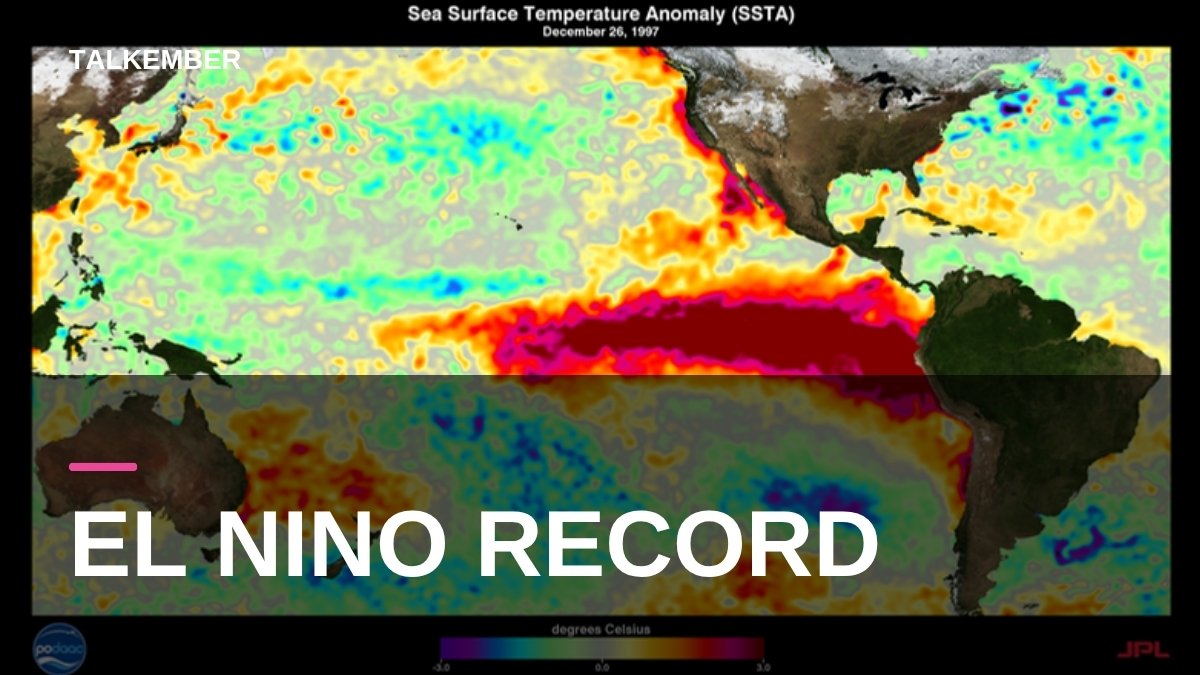
- Japan's weather agency (JMA) says this year's El Niño is the strongest on record, with sea temperatures in its monitoring area 4°C above normal in September, beating the 1997 record of 3.7°C.
- Britain's Met Office calls the event "unprecedented", based on raw sea-surface temperatures in the central Pacific.
- US forecasters at NOAA say it still trails the biggest events in their records, but rate the chance of it becoming the strongest since 1950 as "high".
- The agencies differ because they watch different parts of the Pacific and use different baselines for "normal".
- Scientists agree it is a very strong El Niño that is already disrupting weather in Asia and South America.
Three agencies, three answers
According to AFP, the disagreement is mostly about measurement, not about whether the event is powerful.
| Agency | Verdict | What it measures |
|---|---|---|
| Japan Meteorological Agency | Strongest on record (data back to 1949) | How far temperatures in the Niño 3 region of the eastern Pacific are above normal |
| UK Met Office | "Unprecedented" | Raw sea-surface temperatures in the central equatorial Pacific |
| US NOAA | Not yet the biggest, but likely to be | The Niño 3.4 region in the east-central Pacific, compared with the rest of the tropical ocean |
"By any measure, we are looking at a very strong El Niño," climate scientist Emily Becker of the University of Miami told AFP. She said scientists will only know where it ranks in history once it is over.
What is El Niño?
Normally, trade winds blow from east to west along the equator, pushing warm water from South America towards Asia. During El Niño, which happens every two to seven years and lasts about nine to 12 months, these winds weaken and warm water moves back east. That shift changes where heat goes into the atmosphere, making some regions wetter and others hotter and drier.
Why "normal" is hard to define
Oceans everywhere are warming. So agencies have had to decide what counts as a normal temperature to compare against.
- NOAA and the World Meteorological Organization long used the Oceanic Niño Index, which compares temperatures with a 30-year average updated every five years.
- NOAA now uses the Relative Oceanic Niño Index (RONI), which measures how warm the east-central Pacific is compared with the rest of the tropical ocean. The WMO is switching too.
- Becker said the old index produced a mismatch: La Niña years had stronger effects than their rating suggested, and El Niños weaker ones.
NOAA projects this event will be the strongest in its records if the three-month average RONI reaches 2.5°C or more, which would put it above 1982–83, 1997–98 and 2015–16.
What it is already doing
The Japan Times, citing Bloomberg, reported that El Niño has been linked to:
- the weakest Indian monsoon in more than a decade,
- worse wildfires in Indonesia, whose smoke has drifted over Singapore and Malaysia,
- threats to sugar and coffee output in Brazil.
JMA puts the chance of El Niño lasting through the Northern Hemisphere winter at 100%, in line with the US Climate Prediction Center. Many record-hot years, including 1998, 2016, 2023 and 2024, followed or came alongside major El Niño events.
What to watch
- NOAA's monthly updates, which will show whether the RONI crosses the 2.5°C record line.
- Winter rain and temperature outlooks for South Asia from national weather services.
- Whether 2026 or 2027 sets a new global temperature record, as has happened after past strong El Niños.
Sources
- The Daily Star (AFP) — Record El Nino? Depends who's counting
- The Japan Times (Bloomberg, AFP-Jiji) — El Nino hits record strength, Japan weather agency says
- Japan Meteorological Agency — El Niño Monitoring and Outlook
Spotted a mistake? Tell us — we fix errors and log them on our corrections page.
#el-nino#climate#weather#pacific-ocean#noaa#japan-meteorological-agency#science
Comments (0)