
Navi Pillay wins the 2026 Nobel Peace Prize; hours later the US sanctions the International Criminal Court
In one minute
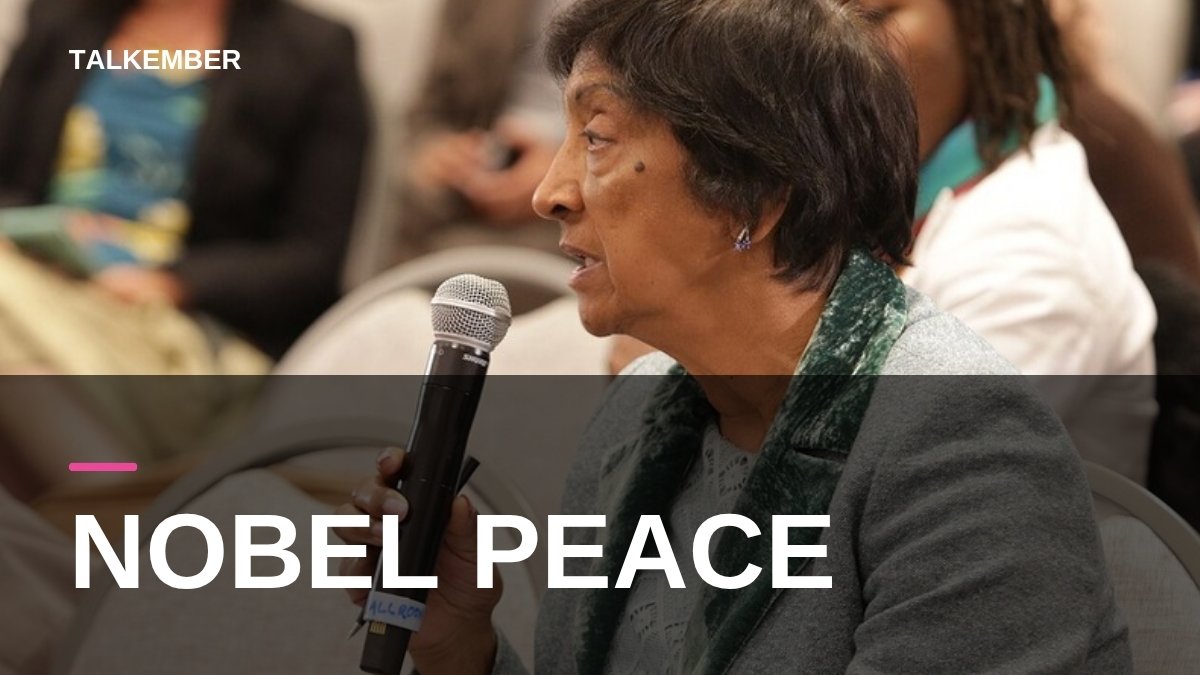
The Norwegian Nobel Committee awarded the 2026 Peace Prize to South African jurist Navi Pillay, 85, a former UN human rights chief and ICC judge, "for her efforts to promote peace and international law". Within hours the Trump administration imposed sweeping sanctions on the International Criminal Court, which called the move an "assault on the rule of law". Donald Trump called the award "disgraceful" and said he should have won.
Key takeaways
- Navanethem "Navi" Pillay, 85, has won the 2026 Nobel Peace Prize "for her efforts to promote peace and international law", the Norwegian Nobel Committee announced in Oslo on Friday, 9 October.
- She is a former UN High Commissioner for Human Rights, a former judge of the International Criminal Court (ICC) and the Rwanda tribunal, and currently sits on the International Court of Justice (ICJ) in the Rohingya genocide case against Myanmar.
- Hours after the announcement, the United States imposed sanctions on the ICC as an institution. Secretary of State Marco Rubio said Washington "will ban transactions with this rogue court". The sanctions come with a six-month grace period.
- The ICC called the sanctions an "assault on the rule of law" and asked its 125 member states to defend it. The EU says the six-month window "offers a window for dialogue".
- President Donald Trump called the committee's choice "disgraceful and embarrassing", said he had "never heard of" Pillay, and repeated that he should have received the prize.
Who is Navi Pillay?
Pillay was born in Durban, South Africa, into a family of Indian Tamil origin, the daughter of a bus driver, and grew up under apartheid. In 1967 she became the first woman to open a law practice in Natal province, and her early work included defending anti-apartheid activists, among them cases connected to Nelson Mandela. She later became the first non-white woman appointed to South Africa's High Court.
Her international career took her to the International Criminal Tribunal for Rwanda, where she served as a judge and for four years as its president. The Nobel Committee highlighted her influence in the tribunal's landmark finding that rape and sexual violence can constitute crimes against humanity and genocide, and in the first prosecution of incitement to genocide based purely on propaganda.
She was elected to the ICC in 2003 and sat on its Appeals Chamber until 2008, then served as UN High Commissioner for Human Rights. From 2021 to 2025 she chaired the UN Independent International Commission of Inquiry on the Occupied Palestinian Territory. Today she is a judge on the ICJ in The Gambia's genocide case against Myanmar over the Rohingya.
She is South Africa's fifth Peace Prize laureate, following in the footsteps of Nelson Mandela and Archbishop Desmond Tutu. According to the Nobel Prize's official account on X, the Peace Prize has now gone to 141 laureates: 113 individuals and 28 organisations.
Why the committee chose her
In its citation, the committee said Pillay "has been instrumental in ensuring that war crimes, crimes against humanity and genocide are prosecuted" and that she has "led the way towards a more comprehensive global legal order". It framed the award as a statement about the state of international law itself, saying the system "is under tremendous pressure, and its institutions are under attack", and that "today, as these same judges are sanctioned, and their institutions are attacked, we need people of courage, vision and determination".
Committee chair Jørgen Watne Frydnes said the panel had not managed to reach Pillay before the announcement. Her first reaction, from Nuremberg's Palace of Justice where she was attending an event, was that "it must be a joke". She dedicated the award to "all the survivors of international crimes" and to practitioners of international justice. Asked whether the award took a position on the Gaza inquiry she chaired, which concluded that Israel had committed genocidal acts, Frydnes said the prize was given "for her whole work".
The US sanctions on the ICC
The Trump administration announced sanctions on the ICC itself later on Friday. Unlike earlier US measures that targeted individual prosecutors and judges, these apply to the court as an institution and could affect companies that provide it with banking, insurance or software services. The US Treasury included a six-month initial grace period and exemptions covering telecoms, software, pension payments and transactions related to detainees.
Rubio said in a statement that "President Trump will never allow the International Criminal Court to prosecute Americans" and that the measures were designed to give the court and its member states a chance to address US concerns. Washington has long objected to the court's arrest warrants for Israeli officials, including Prime Minister Benjamin Netanyahu, and to an investigation of US conduct in Afghanistan that the court says is "deprioritised". The United States signed the Rome Statute that created the court but never ratified it.
The ICC responded that the sanctions are "an assault on the rule of law and on the very foundations of the international legal order", adding that "the court cannot stand alone. Its fate now rests also in the hands of the states that created it". Deputy Prosecutor Nazhat Shameem Khan said investigations and prosecutions would continue. Court officials had reportedly spent months preparing, moving office computers to open-source software and arranging alternative banking and insurance.
Reactions
- Donald Trump told a rally in New York the decision was "a disgraceful and embarrassing decision", said "I never heard of this particular person, but congratulations anyway", and said the United States "represented by me as your president, should have received the Nobel Peace Prize". He also reposted a statement calling Pillay a hater of America and Israel.
- Israel's Foreign Ministry called the award a "grotesque weaponisation" of the prize, citing her role in the Gaza inquiry.
- The EU: foreign policy chief Kaja Kallas said the six-month period "offers a window for dialogue" and that the bloc "has options" to help the court keep working. Belgium's foreign minister called for the EU blocking statute to be activated.
- Pillay herself joked to supporters in Nuremberg: "If you clap a little bit more, I may share this prize with Trump", a nod to last year's laureate, María Corina Machado, who gave her medal to the US president.
Background: the ICC and its critics
The ICC was founded in 2002 to prosecute war crimes, crimes against humanity and genocide when national courts cannot or will not. It has 125 member states, including every EU country and every NATO member except the United States and Turkey. It has issued arrest warrants for more than 70 people, including Russian President Vladimir Putin, Netanyahu, Hamas figures, former Sudanese president Omar al-Bashir and the late Muammar Gaddafi. Pakistan and India are not members of the court.
What happens next
- The six-month grace period runs to roughly April 2027. Watch whether member states, led by the EU, put concrete protections in place for the court's banking and IT.
- The prize will be presented in Oslo on 10 December.
- Trump has said he will not forget what he called a "snub" by Norway. Relations between Washington and Oslo could become a side story in the coming weeks.
Sources
- Norwegian Nobel Committee — Nobel Peace Prize for 2026 (press release)
- BBC News — Navi Pillay, former UN human rights chief, wins Nobel Peace Prize
- RTÉ News (AFP/Reuters) — US imposes sanctions on ICC after former judge wins Nobel prize
- The Nobel Prize on X (@NobelPrize) — announcement and laureate statistics, 9 October 2026
- Reddit r/worldnews — US imposes sanctions on ICC hours after former judge wins Nobel Peace Prize (Reuters link)
Spotted a mistake? Tell us — we fix errors and log them on our corrections page.
#nobel-peace-prize#navi-pillay#international-criminal-court#united-states#donald-trump#world-news#south-africa
Comments (0)